
Project Launch
EU-MICRONESIA Consortium Holds Official Kick-off Meeting
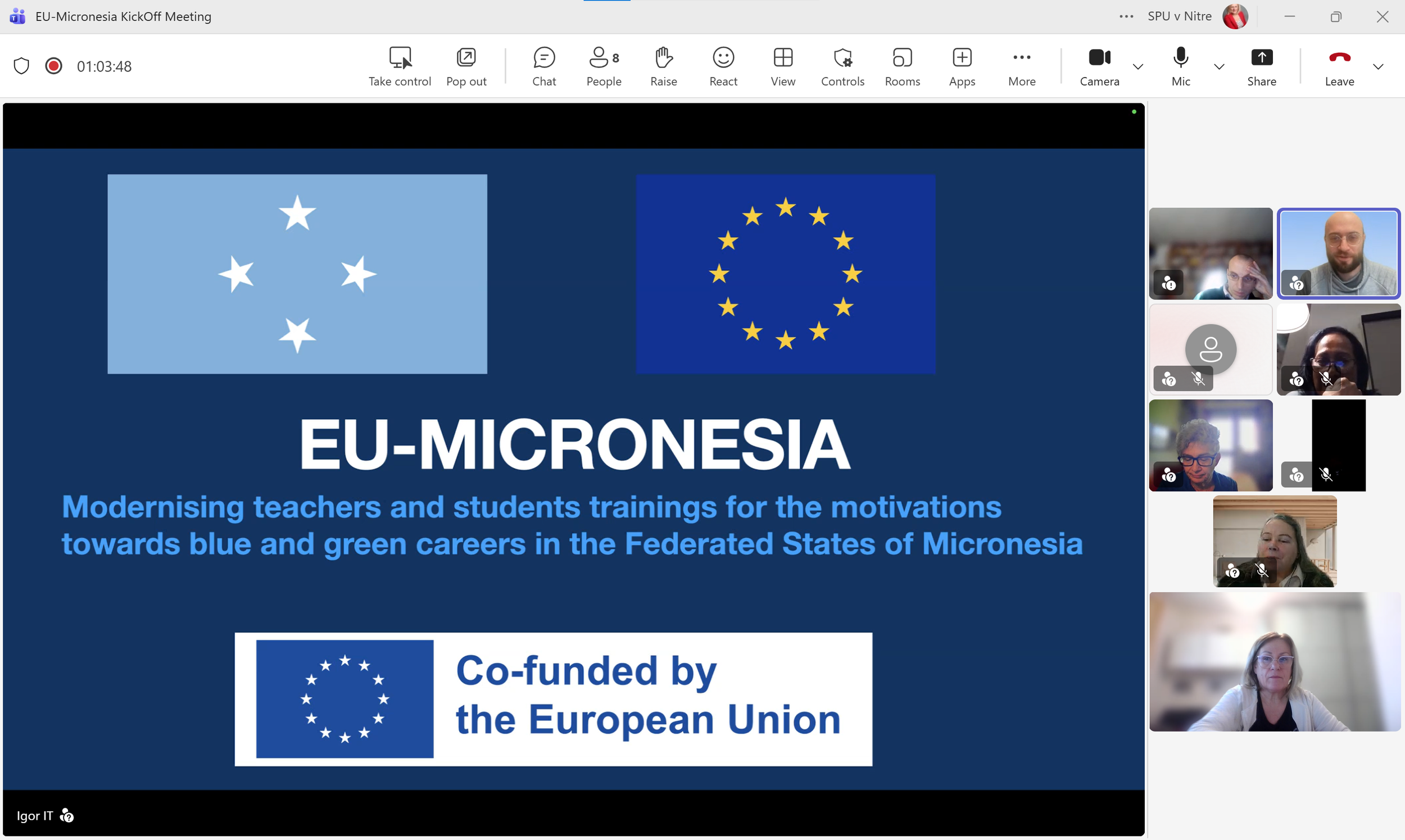
The EU-MICRONESIA project has officially commenced its activities following a successful virtual Kick-off Meeting. This inaugural session brought together all consortium members to align on the strategic roadmap for the next 36 months, focusing on the modernization of higher education in the Federated States of Micronesia (FSM).
Key Priorities and Project Scope
During the meeting, the partners detailed the implementation plan for several core pillars of the project:
Modernizing Teacher Training: Transitioning toward a curriculum that actively motivates students to pursue careers in vital sectors such as sustainable fisheries, agroforestry, and coastal management.
Digital Accessibility: Leveraging digital innovation to overcome the geographical isolation of the FSM's many islands, ensuring that high-quality higher education and professional certification are accessible regardless of location.
Bridging the Gap Between Education and Industry: Establishing a robust alliance with small and medium-sized enterprises (SMEs) to create direct pathways for graduates into the local labor market.
Upcoming Milestones
The first phase of the project will focus on the development of the "Train the Teachers" methodology. This framework will be rigorously tested during pilot training sessions scheduled to take place in Pohnpei. These sessions will involve educators and students working together to refine the approach to career orientation in the FSM.
The EU-MICRONESIA project is funded under the Erasmus+ program and aligns with theThe EU-MICRONESIA project has officially commenced its activities following a successful virtual Kick-off Meeting. This inaugural session brought together all consortium members to align on the strategic roadmap for the next 36 months, focusing on the modernization of higher education in the Federated States of Micronesia (FSM).
A Strategic Partnership for Education and Sustainability
Led by the Slovak University of Agriculture in Nitra (Slovakia), the project is a collaborative effort involving a diverse group of international partners:
Università Cattolica del Sacro Cuore (Italy)
Igor Vitale International srl (Italy)
College of Micronesia-FSM (Micronesia)
National Department of Education (Micronesia)
College of Micronesia Land Grant Program (Micronesia)
The partnership is built on the shared goal of addressing the unique environmental vulnerabilities of the Pacific region by equipping the local workforce with the skills necessary for the "Blue" and "Green" economies.
Key Priorities and Project Scope
During the meeting, the partners detailed the implementation plan for several core pillars of the project:
Modernizing Teacher Training: Transitioning toward a curriculum that actively motivates students to pursue careers in vital sectors such as sustainable fisheries, agroforestry, and coastal management.
Digital Accessibility: Leveraging digital innovation to overcome the geographical isolation of the FSM's many islands, ensuring that high-quality higher education and professional certification are accessible regardless of location.
Bridging the Gap Between Education and Industry: Establishing a robust alliance with small and medium-sized enterprises (SMEs) to create direct pathways for graduates into the local labor market.
Upcoming Milestones
The first phase of the project will focus on the development of the "Train the Teachers" methodology. This framework will be rigorously tested during pilot training sessions scheduled to take place in Pohnpei. These sessions will involve educators and students working together to refine the approach to career orientation in the FSM.
The EU-MICRONESIA project is funded under the Erasmus+ program and aligns with the European Union’s Global Gateway strategy, aiming to foster resilient and sustainable development through education and international cooperation. European Union’s Global Gateway strategy, aiming to foster resilient and sustainable development through education and international cooperation.
